How to Measure Deep Work (In a World Full of Fake Productivity)
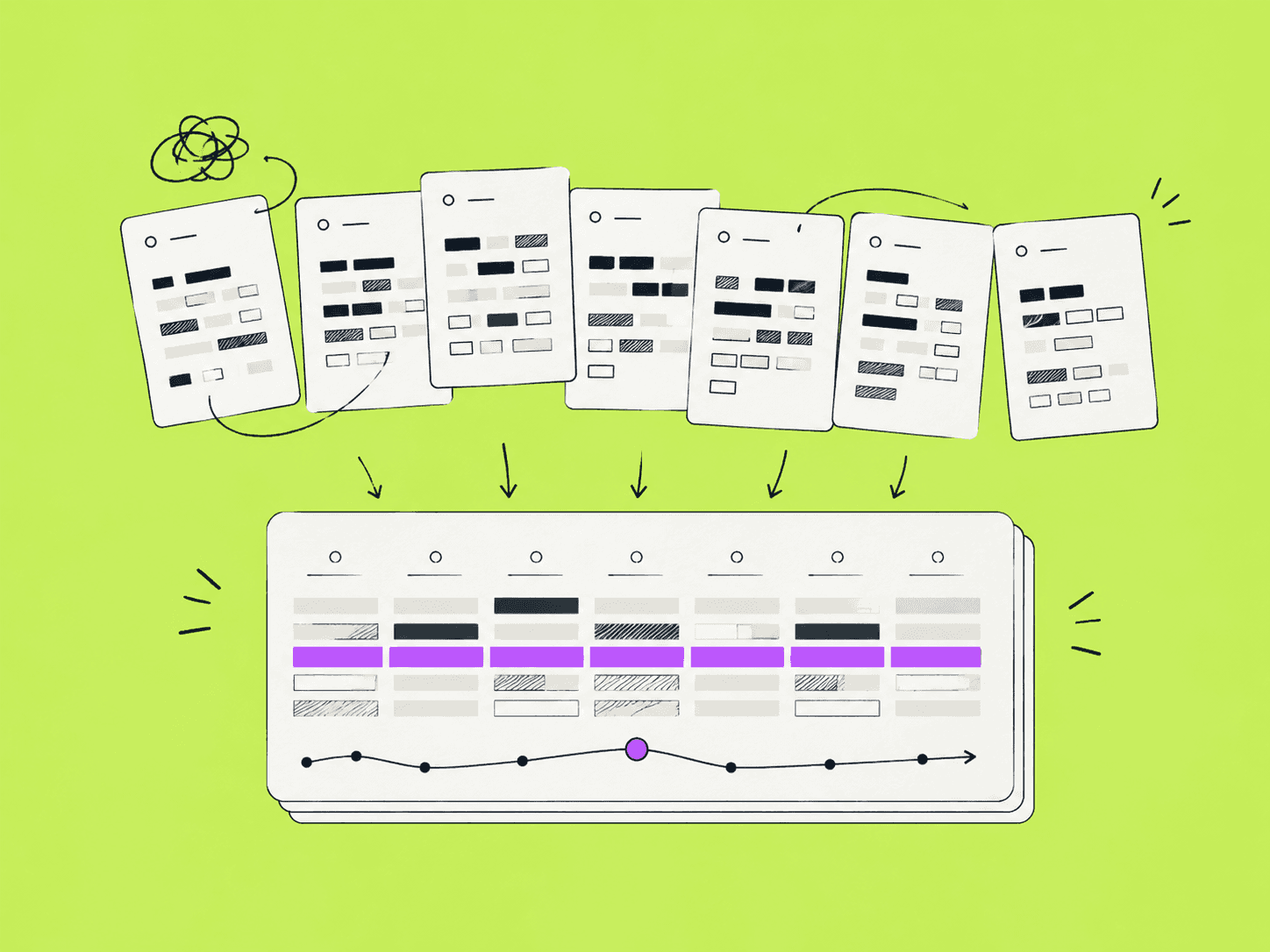
Most people who care about deep work measurement already know what deep work is. They've read Newport. They've restructured their mornings. They've blocked out focus time on their calendar in confident, optimistic chunks. And then they get to the end of a week and have almost no idea whether they actually did any.
That gap — between knowing what deep work is and knowing whether you're doing it — is where most productivity systems quietly fall apart.
This post is about closing that gap. Not with a new philosophy, but with a framework for what deep work measurement actually requires, why the obvious approaches keep failing, and what a credible focus score needs to capture if it's going to tell you something true.
"Hours Worked" Is Not a Deep Work Metric
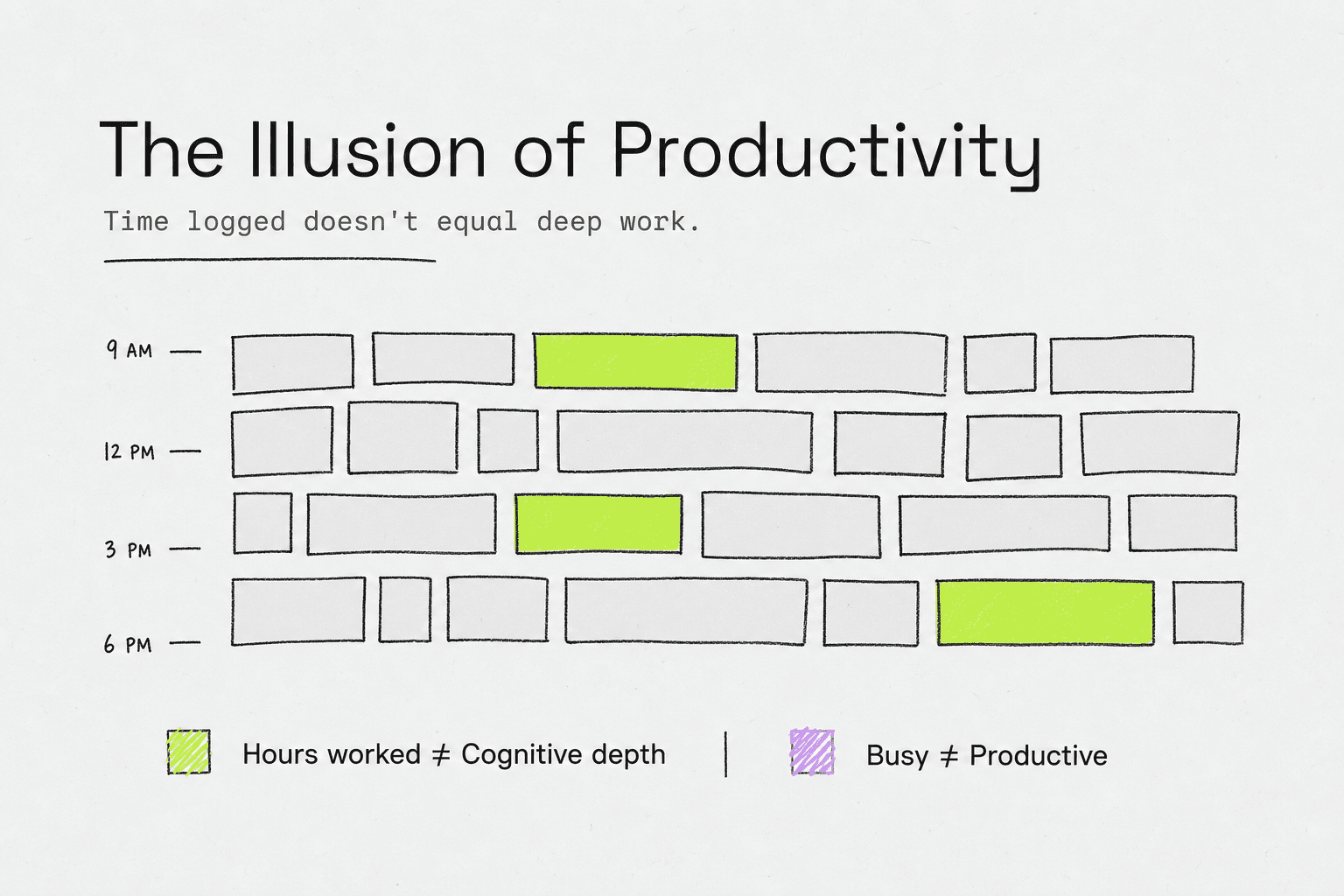
The most common proxy for productive work is time. How long were you at your desk. How many hours you logged. Whether you hit eight hours before you closed the laptop.
This number is nearly useless as a measure of deep work.
Time measures presence. It doesn't measure what was happening inside that presence. A person can spend three hours on a document — writing two sentences, reading those two sentences, checking their email, rewriting the first sentence, opening Slack, closing Slack, returning to the document — and log three hours of work. A person can spend forty-five minutes in a state of genuine cognitive absorption and produce more useful output than the three-hour session generated.
The hours-worked number captures neither of these things accurately. It just counts the time the window was open.
This is the first problem with deep work measurement: the variable most people use as a proxy isn't measuring the thing they think it's measuring. It's measuring occupancy. And occupancy and depth are not the same thing.
The confusion persists because depth is invisible from the outside. Nobody can see concentration. Nobody can observe the difference between a mind working and a mind stalling. So we default to the only variable that's easy to count — time — and tell ourselves it correlates with what we actually want.
Sometimes it does. Often it doesn't.
Deep Work and Focused Work Are Not the Same Thing
Before you can build a framework for measuring deep work, you need to be precise about what you're measuring. And here's a distinction that most tracking systems don't make: deep work and focused work are not identical.
Focused work means the absence of distraction. You're doing one thing. The phone is face-down. No notifications. You're not multitasking. This is a necessary condition for deep work, but it's not sufficient.
Deep work, as the concept is actually used, adds a dimension beyond focus: cognitive demand. It's work that requires sustained reasoning, the kind where you're holding multiple variables in mind simultaneously, building toward something that couldn't exist without that extended mental effort. Writing original analysis. Designing a system. Solving a problem that doesn't have a known answer. Working through an argument.
You can be focused on a task that doesn't require cognitive depth. Processing invoices with your phone off is focused. It's not deep. Reading your own email attentively is focused. It is not deep.
This distinction matters enormously for measuring focus quality, because a metric that only tracks distraction rate will confuse deep work with any kind of uninterrupted activity. The session length looks the same. The interruption count looks the same. But one of these sessions is what Newport means, and the other is just a quiet administrative morning.
A credible deep work metric has to account for cognitive load — not just the absence of interruption.
Why Output-Based Metrics Fail
If time doesn't capture depth, the next instinct is to measure output. Words written. Tickets closed. Code committed. Features shipped.
This sounds more honest. At least it's measuring something real.
The problem is that output metrics collapse the distinction between depth and volume. Some of the most important deep work produces very little visible output. An hour spent genuinely wrestling with a hard architectural decision — one that prevents six weeks of rework — looks like nothing in a commits log. A single paragraph of original thinking that reframes a project can be harder to produce than ten pages of competent-but-shallow prose.
Output-based metrics also have a lag problem. The output from a deep work session often appears days or weeks later. The thinking you did on Tuesday shows up in the quality of the decision you make on Friday. There's no obvious way to draw the line from the metric back to the session.
And output metrics invite gaming. If words written is the number, people write more words. If tickets closed is the number, people close more tickets, including the ones that didn't need to be opened. The metric starts to shape the work rather than describe it.
Good deep work metrics don't measure what came out of the session. They measure the quality of the conditions inside it.
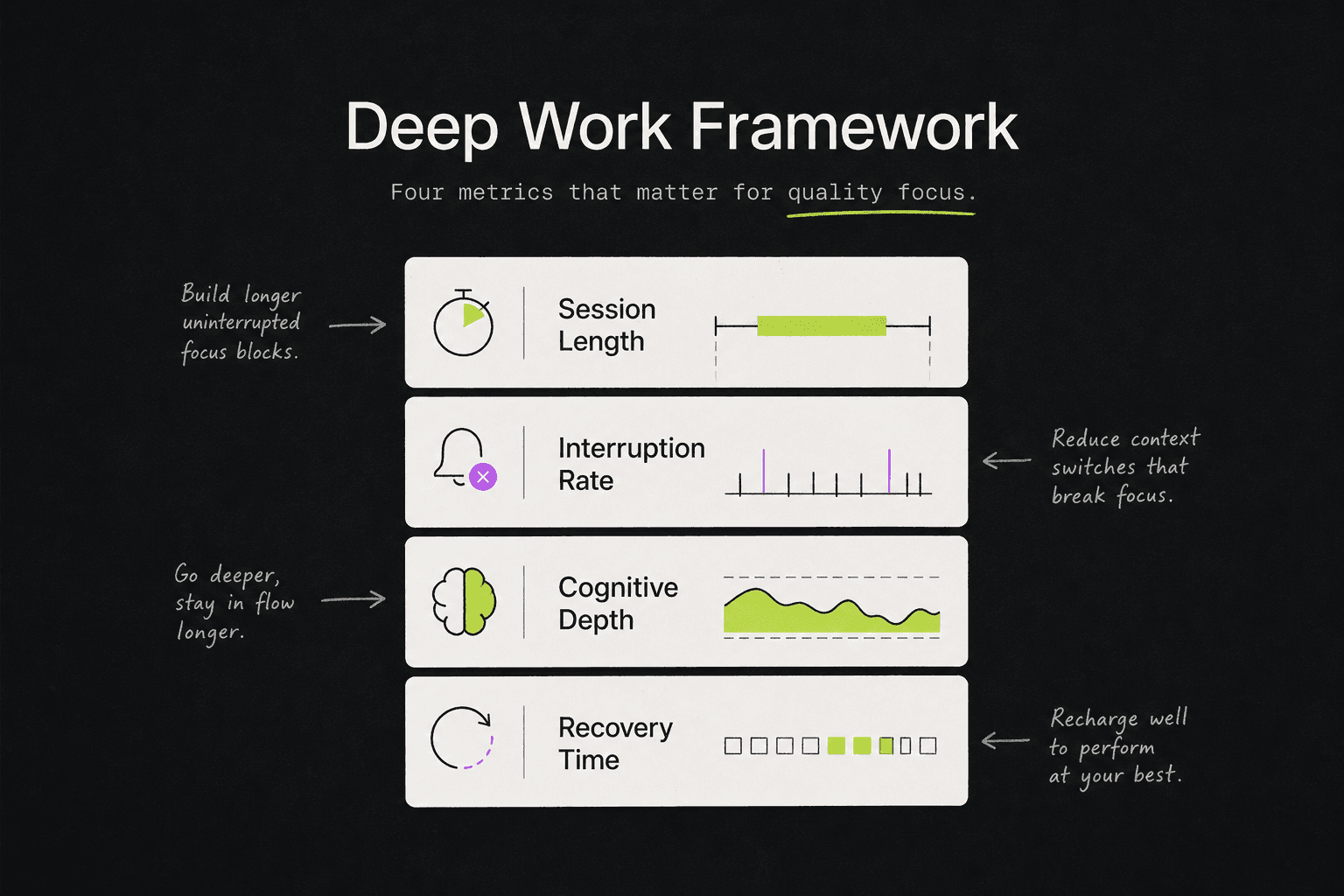
The Four Things a Deep Work Metric Actually Needs to Capture
If hours-worked fails, output fails, and a simple distraction count doesn't capture cognitive load — what does a real deep work metric need to measure?
Four things.
Session length. Not total time logged, but the duration of the unbroken session. There's a meaningful difference between two hours of sustained work and four thirty-minute blocks with context-switching between them, even if the clock says the same number. Depth requires a runway. The first several minutes of any serious cognitive task are usually spent re-entering the problem space. The actual work happens after that. A metric that can't distinguish a two-hour unbroken session from a fragmented two hours is missing the most important variable.
Interruption rate. How many times the session was broken, and how significantly. Not all interruptions are equal. Checking a Slack notification and returning within ten seconds is different from leaving the task, answering a question, having a conversation, and returning five minutes later. A useful metric needs some resolution here — not just a binary interrupted/not-interrupted flag, but some sense of how many times the session was punctured and how badly.
Cognitive depth. This is the hardest variable to capture, because it's inherently subjective. But it's not impossible to estimate. The question is: how demanding was this work, really? Was it the kind where you were genuinely reasoning through something, holding complexity, making non-obvious decisions? Or was it competent execution of a known process? These feel different from the inside. A metric that asks a person to report on this — without requiring them to produce a paragraph of reflection — can capture enough signal to be useful, even if it's imprecise.
Recovery time between sessions. Deep work metrics almost never measure this, but they should. A person who does four hours of genuine deep work in a single day without adequate transition time between sessions doesn't produce four hours of deep work quality. They produce something more like two hours of deep work quality and two hours of degraded-but-present work that looked like deep work. The recovery period — the gap between sessions, the transition, the deliberate decompression — is part of the deep work infrastructure. A framework that ignores it is measuring something incomplete.
Why Common Tracking Approaches Keep Getting This Wrong
The most popular methods for how to track deep work fail on one or more of the above dimensions. Not because they're badly designed, but because they're solving a slightly different problem.
Time trackers — the Toggl-and-Clockify family — are built to log presence and categorise activity. They're excellent at telling you how much time you spent in a category. They're not built to tell you anything about the quality of that time. A toggled session of "deep work" that contains twelve interruptions looks identical to one that contained zero. The tracker logs the category; it doesn't observe what happened inside it.
Pomodoro logs measure intervals, not depth. The Pomodoro system is a useful tool for structuring work sessions, but the twenty-five-minute interval is an arbitrary commitment device, not a unit of cognitive depth. Completing ten Pomodoros tells you that you sat down to work ten times. It tells you almost nothing about the depth of any of those sessions. And the five-minute breaks built into the system, while useful for sustainability, actively fragment the unbroken session length that deeper work sometimes requires.
End-of-day self-ratings — "rate your focus today from 1 to 10" — have the opposite problem from time trackers. They're capturing something real: the subjective experience of the day. But they're too coarse, too retrospective, and too vulnerable to recency bias. How you feel at 6pm colours your rating of the entire day. A morning of excellent deep work followed by an afternoon of fragmented meetings will be rated lower than it deserves because the meetings are what you're remembering. Asking someone to summarise eight hours of cognitive experience in a single number at the end of the day is asking them to do something their memory can't reliably do.
Activity monitors — tools that track which apps you're using and for how long — measure the surface of behaviour without touching its quality. Spending two hours in a word processor looks the same whether you're writing at the edge of your ability or deleting and rewriting the same sentence. The tool can't see inside.
This is the shared failure mode: every common approach measures something adjacent to deep work quality without measuring it directly. They're measuring the container, not what's in it.
The Frequency Problem — and Why It Matters More Than You Think
There's a structural problem with almost all self-tracking approaches that gets less attention than it deserves: the observation point.
Most tracking methods ask you to report on your work either at the moment of starting a session (which means you're predicting, not measuring) or at the end of the day (which means you're reconstructing from memory). Both of these produce worse data than observations taken closer to the actual moments.
Memory for the quality of cognitive experience degrades quickly and unevenly. A day that contained three hours of good deep work and five hours of fragmented, shallow-but-busy activity will be remembered as moderately productive or unproductive — the fragmented majority tends to dominate the impression, regardless of what the first three hours produced. Asking someone to accurately report on session depth twelve hours after it happened is asking more of human memory than human memory can reliably deliver.
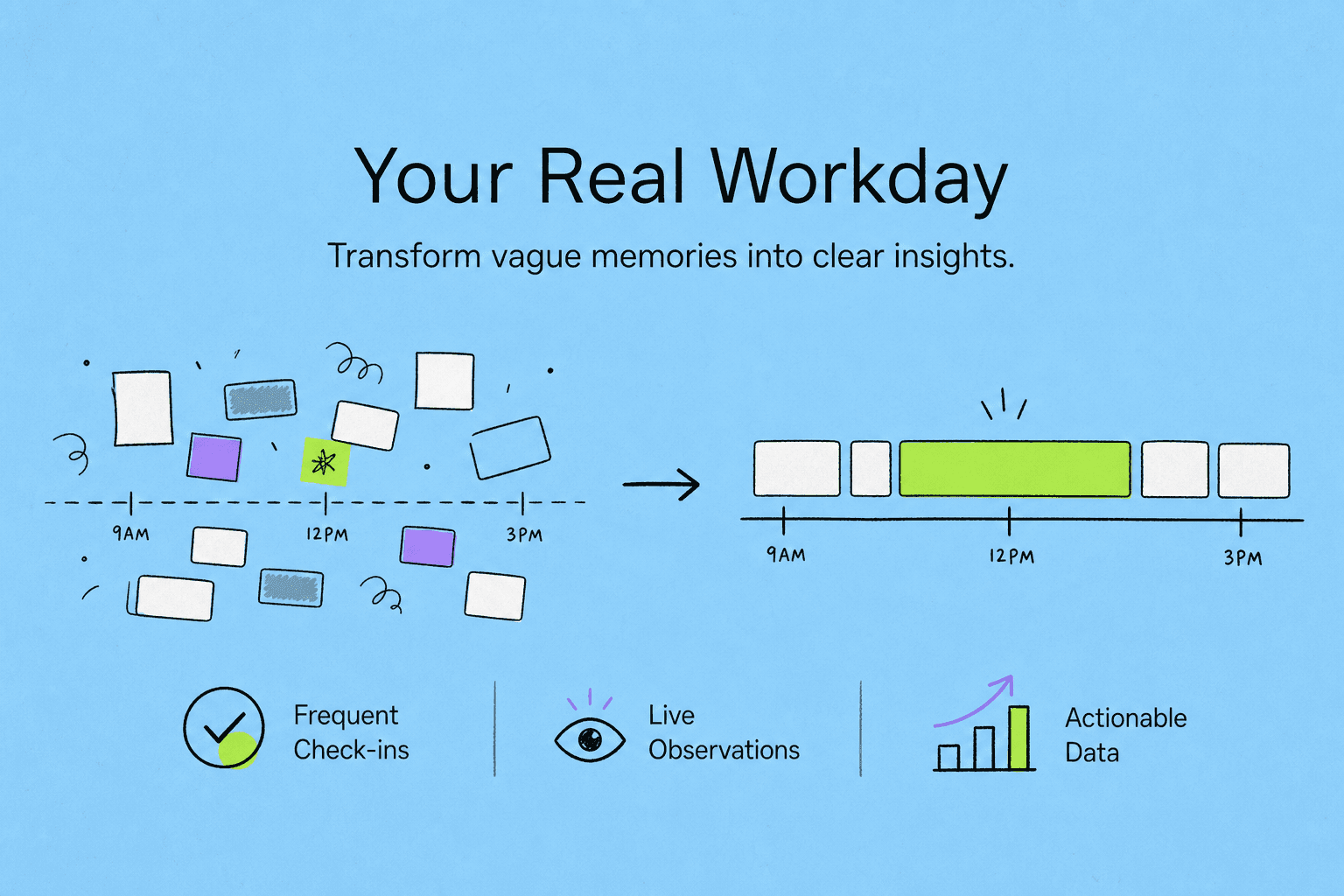
The implication is that regular short check-ins — taken closer to the actual work, multiple times across the day — produce fundamentally better data than a single end-of-day review. Not because the check-ins are more accurate in each individual instance, but because they're sampling the day across time rather than reconstructing it from a single endpoint.
This isn't how most people think about deep work tracking. They think about it as a log you maintain or a rating you assign. The check-in model is different: it's a time audit conducted in real-time, sampling your actual experience as it happens, before the day has had a chance to collapse into a single feeling.
The ADHD-adjacent reader will recognise something here. One of the defining features of ADHD time blindness is that time doesn't feel like it's passing — hours vanish and there's no internal record of where they went. A single end-of-day review is the worst possible method for someone whose relationship with time is already unreliable. Frequent lightweight sampling across the day creates the record that memory was never going to preserve.
A Practical Framework for Scoring a Deep Work Session
Here's a working framework. It's not a formula with precise weights, because the research doesn't support that kind of precision and pretending otherwise would be dishonest. But it describes the inputs that matter and how to think about them together.
Input 1: Unbroken session length. Score higher for sessions that weren't fragmented. The threshold where depth becomes possible is different for different people and different kinds of work, but most serious cognitive tasks need something in the range of forty-five minutes to two hours of unbroken attention before they produce their best output. Shorter isn't necessarily worse — a sharp thirty-minute session can be genuine deep work — but sessions under twenty minutes rarely qualify regardless of their content.
Input 2: Interruption count and severity. How many times did you leave the work? How long were you gone? One two-minute interruption in a ninety-minute session is qualitatively different from six interruptions of similar duration. A simple count of interruptions, weighted loosely by their duration, captures most of the signal you need.
Input 3: Cognitive depth estimate. This is a self-report, and it needs to be taken close to the session — not twelve hours later. The question isn't "how hard did you work" (which invites performance bias) but something more specific: "how much genuine reasoning were you doing, and how much was execution of a known process?" Most people can answer this honestly if they're asked before they've had time to construct a narrative about their day.
Input 4: Transition quality. Did you return to this work from something fragmenting — a meeting, an inbox, a conversation — or from adequate recovery time? The deep work metrics that ignore entry conditions are ignoring something that meaningfully affects session quality.
A focus score built from these four inputs doesn't need to be a single precise number. It can be a rough composite — a sense of how the session sat across these dimensions — that's taken close to the work rather than reconstructed at day's end. Imprecise, close-to-the-moment data beats precise, retrospective data almost every time.
Where Daibrief's Focus Score Fits
Most of the deep work tracking tools that exist are solving the wrong problem. They're building better containers — more sophisticated time buckets, prettier calendars, longer streaks — without touching the quality question at all.
Daibrief approaches this differently. The app sends a notification every thirty minutes during your working hours. You respond with a voice check-in that takes under five seconds. That check-in — taken live, during the day, before memory has done its work — captures what you were doing and how the work was actually going. At the end of the day, the AI synthesises those check-ins into a daily work log: a summary of where your time actually went, not where you intended it to go.
The focus score is built from this. Not from a single end-of-day self-rating, not from app-usage data, not from a calendar — but from multiple real-time observations spaced across the day, aggregated into something that reflects session quality rather than session presence. It addresses the frequency problem directly: the check-ins are taken close to the work, before the day collapses into a single feeling.
This is the practical answer to the measurement problem this post has been building toward. Not a new philosophy of work. A different observation structure — one that captures the inputs that matter rather than the proxies that are easy to count.
What "Good" Actually Looks Like
One of the reasons deep work measurement stays abstract is that people want a target to hit, and sensible frameworks are reluctant to prescribe one.
There's no universal right answer for how many deep work hours per day is enough, or what focus score constitutes a good week. Anyone who gives you a specific number without knowing your work, your role, your cognitive load outside of work, or your baseline capacity is telling you something confident and useless.
What good patterns tend to look like — based on what the framework above would capture — is something like this:
Long-session days followed by necessary recovery. Work that involves a mix of genuine depth and lighter processing, with some intentional structure around which is which. Fewer interruptions than the person believes they're experiencing. Entry conditions that are at least sometimes adequate. And some consistent ability to distinguish, at the end of a week, between days that contained real cognitive work and days that contained a lot of activity.
That last one — the ability to distinguish — is actually the most important thing a deep work measurement practice can give you. Not a score to optimise. Not a number to beat. Just honest information about what your work actually consisted of, so you can make decisions about it that are based on something real.
Most people don't have that. They have a vague impression of how productive they were, shaped heavily by how they feel right now, coloured by whatever the last two hours contained. A genuine approach to measuring deep work hours gives you something to work with instead of a feeling.
Why Measuring Deep Work Hours Requires a System You'll Actually Use
The best measurement framework in the world produces nothing if it requires too much effort to maintain.
This is where almost every serious attempt at measuring deep work falls apart. The system is too manual. It requires updating a spreadsheet. It requires opening an app and logging a session with tags and categories and time stamps. It requires more cognitive overhead than the person can reliably sustain while also doing the work they're trying to measure.
Any deep work metric that depends on manual session logging will produce data that reflects the person's motivation to log, not the person's actual work. The busy weeks — the weeks when the data would be most interesting — are exactly the weeks when logging falls off.
This is why the observation structure matters as much as the metrics themselves. A system that requires nothing beyond a five-second voice response to a prompt that arrives automatically is structurally different from one that requires deliberate action. The data quality isn't just about what you're measuring. It's about how frequently the measurement actually happens.
The other thing a measurement system needs to do is give you information you can act on. A daily work log that shows you the shape of your week — when depth was happening, when it wasn't, what patterns are consistent across days — gives you something to reason from. A single focus score at the end of the week tells you whether it was good or bad but not what made it so.
Granularity matters. Frequency matters. And the friction of recording needs to be low enough that it doesn't corrupt the thing it's trying to observe.
The Difference Between Measuring Depth and Performing It
There's a version of deep work measurement that becomes its own form of fake productivity.
Careful time-blocking. Colour-coded calendars. An elaborate daily review practice. A hand-maintained spreadsheet with a focus column. The measurement practice starts to feel like the work. It looks productive. It signals seriousness. It doesn't necessarily produce better data or better work.
The goal of measuring deep work is not to have a more sophisticated relationship with your calendar. It's to get honest information about the quality of your cognitive work over time — information you can use to make real decisions. Which days were you actually getting work done? Which conditions correlated with better sessions? Where is your attention actually going, as opposed to where you think it's going?
Those are valuable questions. They deserve an honest measurement approach — one that captures what the other methods miss, takes the observation point seriously, and costs less effort than it returns.
The hardest part of deep work measurement isn't designing the framework. It's accepting that you might not like what the data shows. That the four-hour block you protected carefully contained maybe ninety minutes of actual depth. That the days you felt most productive were not always the days you produced the most meaningful work. That knowing this is better than not knowing it, even when it's uncomfortable.
Measurement that produces comfortable numbers is performance. Measurement that produces accurate numbers is useful.
The point isn't to feel better about your focus. It's to know something true about it.
Frequently asked questions
How many hours of deep work per day is realistic?
There's no number that holds across all people, roles, or types of work. What the evidence from practitioners and researchers broadly suggests is that sustained high-quality deep work is harder to maintain for long unbroken stretches than most people expect — and that most knowledge workers significantly overestimate how much of their day actually qualifies. The more useful question is not how many hours you should aim for, but how many hours you're currently achieving, and what conditions produce your best sessions.
Can you measure deep work without a dedicated app?
Yes, with some limitations. A paper log or a simple notes document, updated frequently across the day rather than at the end of it, can capture most of the relevant inputs — session length, interruption count, a rough cognitive depth rating. The problem with manual systems is consistency: they work well when motivation is high and break down during the weeks when the data would be most informative. Any measurement method that requires significant deliberate effort will produce data shaped by that effort requirement rather than purely by the work itself.
What's the difference between deep work and flow state?
Flow state is a psychological condition — a specific experience of effortless absorption where challenge and skill are matched and time distorts. Deep work is a type of cognitive activity: demanding, distraction-free work that produces value precisely because it requires concentration most people can't sustain. The two can overlap — deep work can produce flow — but they're not the same thing. You can do genuine deep work without entering flow. And flow can occur during activities that don't meet Newport's threshold for cognitive demand. Deep work is the practice; flow is one possible phenomenology of it.
How do interruptions affect deep work quality, and how do you account for them in a score?
Interruptions affect deep work in two ways: they break the session, and they leave a residue that degrades the session's remaining quality even after you've nominally returned to the work. Research on attentional residue suggests that the cost of an interruption extends well beyond the interruption itself — part of your attention stays with whatever interrupted you. For a scoring framework, this means interruptions shouldn't be treated as a simple binary. A count weighted by severity — brief self-interruptions versus extended departures from the task — captures more of the real impact than either ignoring them or counting them equally.
Daibrief checks in every 30 minutes and turns your voice into a daily work log. Free for 7 days.