What Is Time Blindness? A Complete Guide for People Who Lose Hours Without Noticing

You sit down to work at 9am. You look up and it’s 2pm. You have no reliable account of what happened in between.
That’s not laziness. That’s not poor discipline. That’s time blindness — a real, neurologically grounded phenomenon that affects far more people than the clinical literature would have you believe.
This guide covers what time blindness actually is, who it affects, why the brain does it, and what tends to help. It’s long because the topic deserves it, not because we needed the word count.
Your Brain Has Two Modes, and One of Them Ignores the Clock
Most people assume that everyone experiences time roughly the same way — a steady, ambient awareness of minutes passing, like a clock quietly ticking in the background.
For many people, that’s simply not how it works.
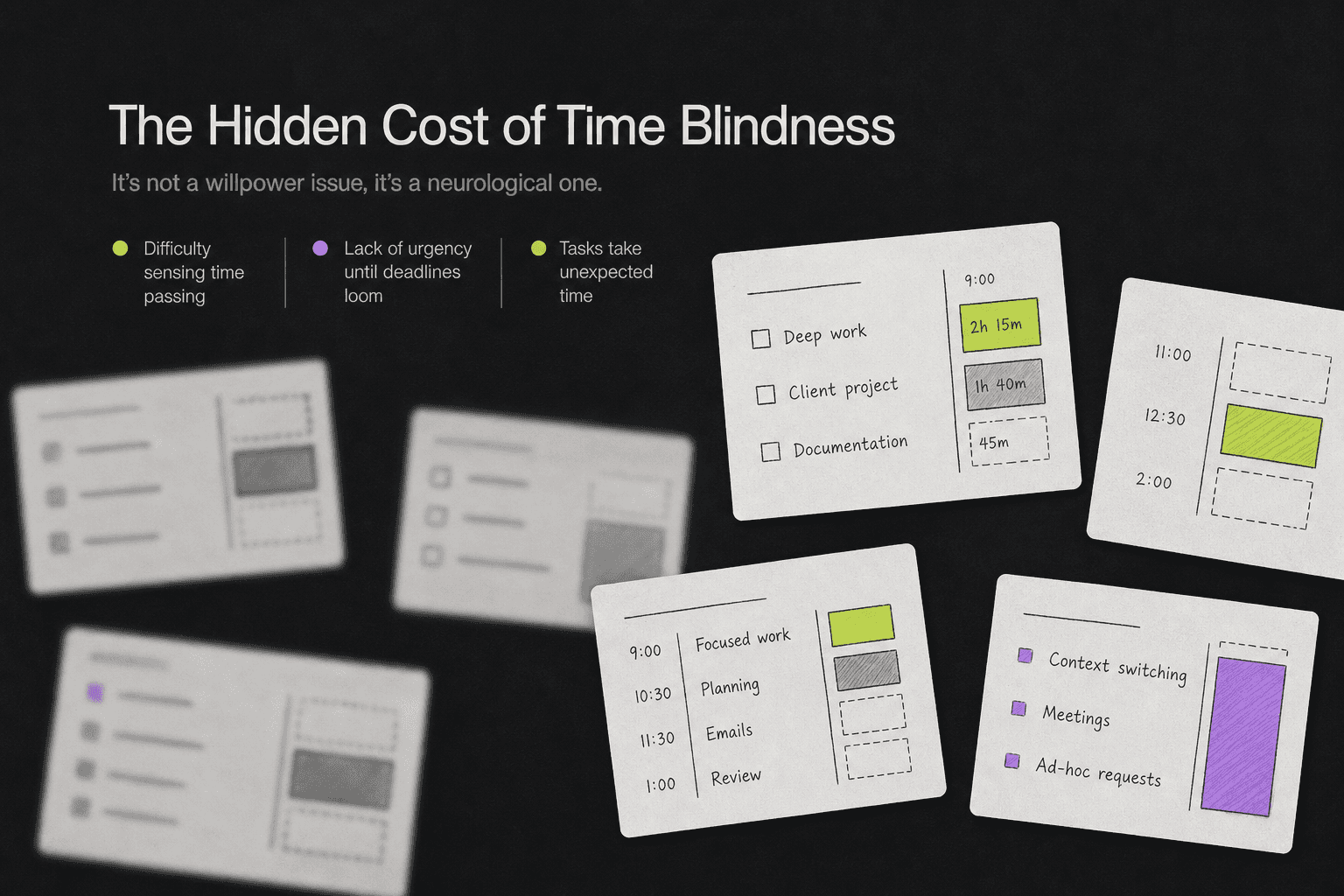
Time blindness refers to an impaired ability to sense time passing, to estimate how long tasks take, and to feel the pull of a future deadline until it’s almost too late to act on it. It’s not about forgetting appointments. It’s about a near-total absence of the internal signal that tells you a minute has passed, or twenty, or ninety.
People who experience this often describe time as existing in two states: now and not now. A meeting in four hours doesn’t feel meaningfully different from a meeting in four days. Both are just “later.” Until suddenly, they’re not.
The Neuroscience Behind Why Some Brains Can’t Feel Time
The brain regions most associated with time perception — the basal ganglia, the prefrontal cortex, the dopaminergic pathways — are the same ones heavily implicated in ADHD.
Dopamine plays a central role here. It’s not just the “reward chemical.” It’s involved in how the brain marks intervals, anticipates consequences, and maintains a working model of what’s happening now versus what’s coming next. When dopamine regulation is off, that internal metronome gets unreliable.
This is why ADHD time blindness is so common — and so misunderstood. People with ADHD aren’t choosing to ignore time. Their brain’s timekeeping machinery is running on faulty signals. The urgency that neurotypical people feel building gradually toward a deadline often doesn’t arrive until the deadline is immediate. Then it arrives all at once.
But ADHD isn’t the only context. Anxiety, depression, sleep deprivation, deep focus states, and certain medications can all distort time perception in similar ways. The experience isn’t exclusive to any one diagnosis.
Who Actually Experiences This (It’s More People Than You Think)
The clinical conversation about time blindness tends to center on ADHD diagnoses, and for good reason. It’s one of the most consistent and least-discussed features of the condition.
But if you mapped everyone who has genuinely lost track of where their day went — not once, but regularly, in a way that affects their work and their self-image — you’d capture a much wider group.
Knowledge workers who enter deep focus states and surface hours later. Founders who spend a Tuesday “thinking and emailing” and can’t reconstruct the day by 6pm. Creative professionals whose best work happens in a kind of timeless absorption that’s genuinely incompatible with watching a clock.
The question “where does my time go?” isn’t rhetorical for these people. It’s a genuine mystery they revisit every week.
And the standard advice — use a calendar, try time blocking, set a timer — doesn’t solve the underlying problem. It just adds more systems to ignore.
Why Time Tracking Tools Usually Make This Worse
Here’s what most productivity advice misses: if you have trouble sensing time passing, you also have trouble remembering to log it.
Manual time tracking requires you to notice a transition, pause, open an app, categorize what you just did, and then resume. That’s four or five steps that all depend on the one thing time blindness takes from you — awareness that time has been passing.
So you forget to log. Or you log a rough reconstruction at the end of the day, which is mostly fiction. Or you use a tool for three days and abandon it because the friction is too high and the payoff feels too abstract.
A time audit sounds reasonable in theory. In practice, it assumes a level of time awareness that many people are trying to build in the first place.
This is the loop people get stuck in. They know they need to understand their time better. Every tool available to help them requires them to already have the skill they’re trying to develop.
The Emotional Layer That Nobody Talks About Enough
Time blindness isn’t just a productivity problem. It has a shame layer.
When you consistently can’t account for your day, you start to internalize the explanation that most of the world offers: you’re disorganized, you’re not trying hard enough, you need a better system.
You’ve tried the systems. You’ve bought the planners and the apps and the Pomodoro timers. You’ve had the productivity phases that last ten days before collapsing. And each time a system fails, the explanation you’re handed is that you failed the system.
What rarely gets said is that the systems were designed for people who already have a functional sense of time. They’re refinements on a baseline most of us assume everyone shares.
Recognizing time blindness as a genuine cognitive difference — not a character flaw — isn’t giving yourself an excuse. It’s giving yourself an accurate diagnosis so you can find interventions that actually address what’s happening.
What the Research Suggests About Managing Time Blindness
The interventions that tend to work share a common feature: they externalize the sense of time rather than demanding you develop it internally.
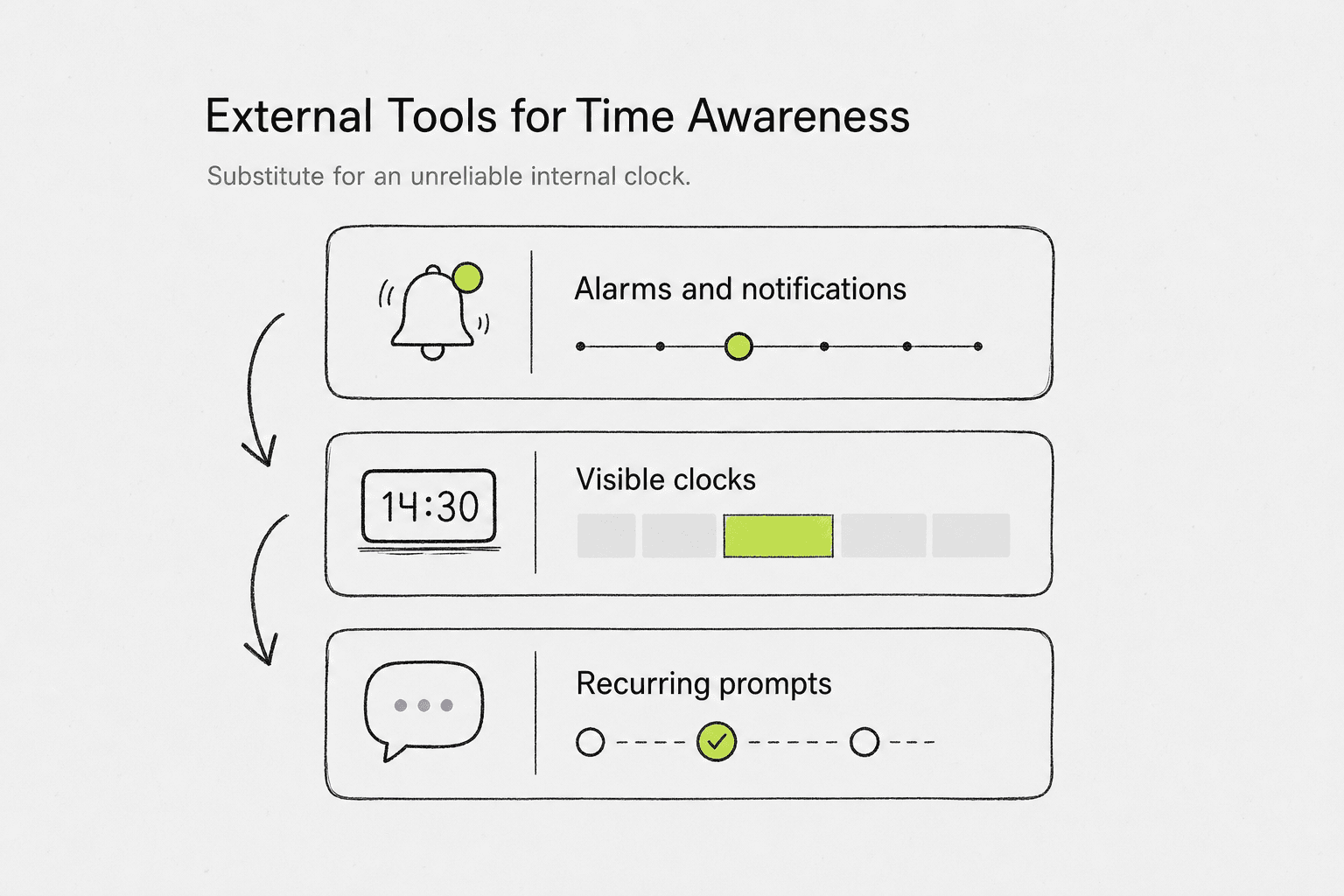
External time cues — alarms, notifications, visible clocks, recurring prompts — act as a prosthetic for the internal signal that isn’t firing reliably. They don’t fix the underlying wiring, but they substitute for it in practical terms.
For people with ADHD, medication often helps by improving dopamine regulation, which sharpens time perception in parallel with other executive function improvements. But medication alone doesn’t automatically teach you to reconstruct where your time went.
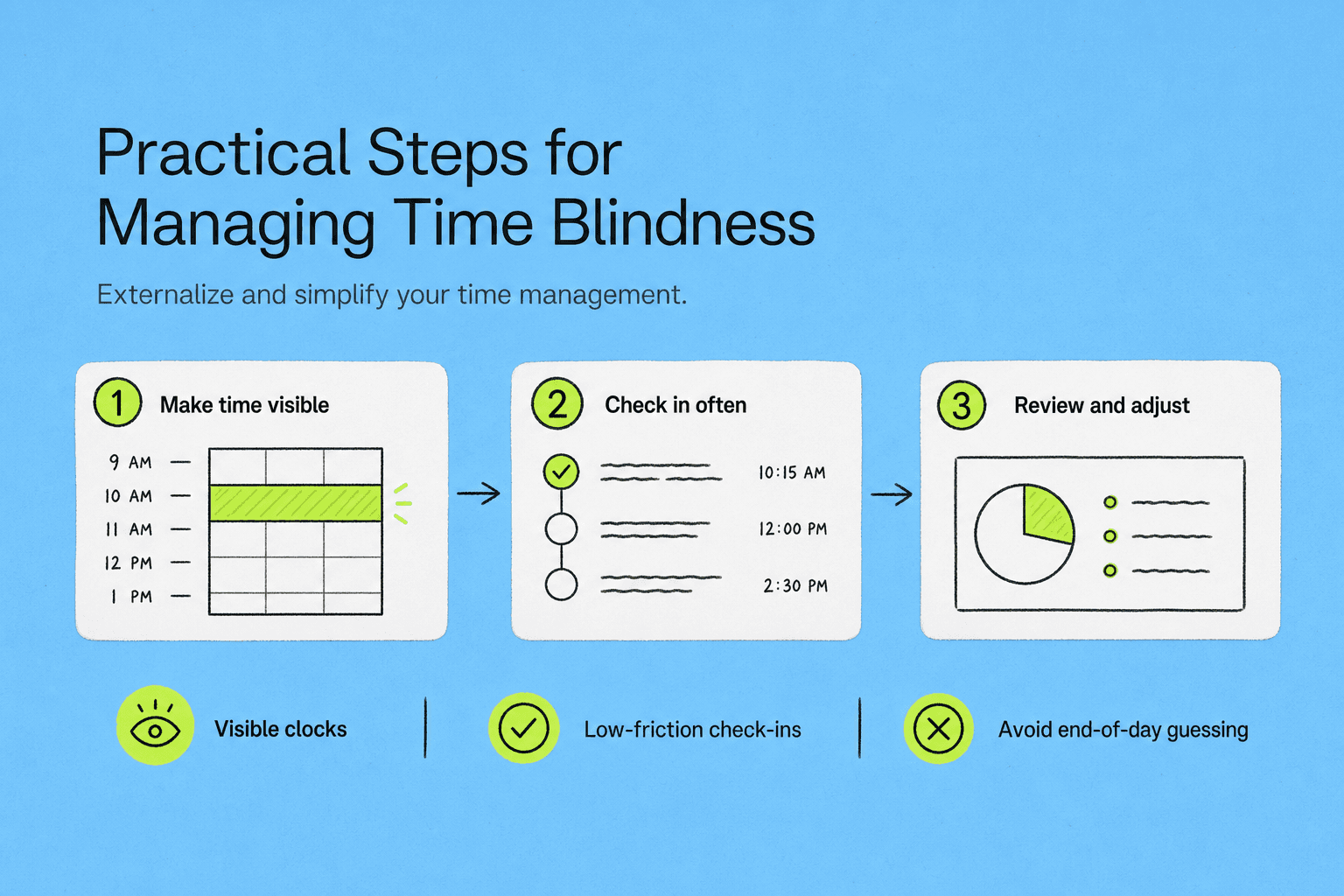
Regular, low-friction check-ins throughout the day appear more useful than comprehensive end-of-day reviews, because the review is trying to recover information that was never captured in the first place. By the time you sit down to log your day, most of it is genuinely gone from memory.
The goal isn’t perfect time tracking. It’s building enough signal during the day that you have something real to work with afterward.
This is exactly the problem Daibrief was built around. Instead of asking you to track your time, it checks in every 30 minutes with a notification. You respond in under 5 seconds with a voice note — just enough to capture what you were actually doing. At the end of the day, the AI generates a summary of where your time actually went, built from your own words rather than a reconstruction from memory. For people who lose hours without noticing, that’s not a new system to maintain. It’s a nudge, repeated, and a record that builds itself.
Practical Things That Help Right Now
You don’t need a diagnosis to start working with your time blindness rather than against it.
Externalize time constantly. Analog clocks in your peripheral vision. A large digital clock on your monitor. Time shown in your menu bar. The more visible time is, the less you have to sense it.
Reduce the friction of capture. The harder it is to log something, the less you’ll do it under pressure. Voice is faster than typing. Something that prompts you is more reliable than something you have to remember to use.
Stop trying to reconstruct your day at 6pm. That’s not a time audit, it’s a guess. The information you need has to be captured while the moment is still live.
Be honest about what “deep work” costs you. Focused, absorbed work is valuable. But if you routinely surface from it with no idea what time it is or how long you’ve been there, you’re paying an accounting cost that adds up.
Stop framing this as a willpower problem. That framing has failed you already. Try framing it as an infrastructure problem — one that responds to external systems, not internal effort.
A proper daily work log, built from real-time inputs rather than end-of-day guesses, changes what’s possible. Not because it makes you more disciplined. Because it stops asking discipline to do a job it was never equipped for.
Frequently asked questions
Is time blindness a real condition, or just an excuse?
It’s real — neurologically grounded, not a character flaw or rationalization. It’s closely associated with ADHD and impaired dopaminergic function, but it also affects people without a formal diagnosis. Calling it an excuse confuses the cause with the behavior. Understanding what’s actually happening is the starting point for addressing it effectively.
Can time blindness be fixed, or just managed?
For most people, it’s managed rather than fixed. External systems — reminders, cues, low-friction check-ins — work because they substitute for the internal signal that’s unreliable. Some people find that medication, sleep improvements, or reduced cognitive load softens the effect. But trying to train your way to a normal time sense through willpower alone tends not to work.
I don’t have ADHD. Can I still experience time blindness?
Yes. Deep focus states, anxiety, depression, poor sleep, and high cognitive load can all distort time perception in similar ways. ADHD is the most studied context, but the experience of losing track of hours, struggling to estimate task duration, or failing to feel urgency about upcoming deadlines is common well beyond any single diagnosis.
Why do timers and time-blocking apps fail for people with time blindness?
Because they assume you already notice time passing. A Pomodoro timer doesn’t help if you forget to start it. Time blocking doesn’t help if you lose track of which block you’re in. Manual logging fails because it requires you to notice and act on a transition — exactly the moment time blindness takes from you. The tools designed to help require the skill you’re trying to build.
What’s the difference between time blindness and just being bad at planning?
Poor planning usually means underestimating task complexity or failing to account for interruptions. Time blindness is more fundamental — it’s a misfiring of the mechanism that senses duration itself. Someone with poor planning skills can usually reconstruct their day accurately. Someone with time blindness often genuinely cannot account for where two or three hours went, because the experience of those hours didn’t register clearly while they were happening.
—
Daibrief checks in every 30 minutes and turns your voice into a daily work log. Free for 7 days.